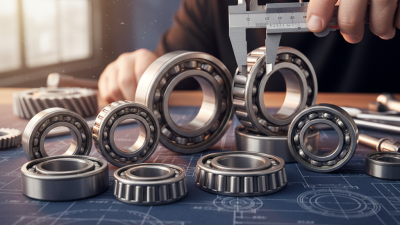
Choosing a China-based Ina Needle Bearing supplier requires more than comparing online prices. Global buyers need consistent dimensions, clear material data, and dependable export communication. A bearing may look correct on a product page, yet small bore tolerance differences can affect noise, heat, and service life. Real procurement experience shows that samples should be checked before large orders. Measure the inner diameter. Inspect the cage. Confirm the grease specification. These details matter.
This guide examines how to identify a reliable supplier for INA needle bearings, including manufacturing capability, quality inspection, documentation, packaging, and after-sales support. It also considers whether the supplier is an authorized channel, a qualified distributor, or an independent manufacturer. That distinction deserves attention. Buyers should request traceability records, inspection reports, and practical delivery evidence, rather than accepting polished claims. Certifications can support trust, but they do not replace product testing. A careful supplier will discuss application load, speed, temperature, and fit openly. No supplier is perfect. Communication gaps, changing lead times, or incomplete technical files can still appear. Recognizing these risks helps purchasing teams compare offers fairly and protect equipment performance across different markets.
What Defines a Top INA Needle Bearing Supplier in China
A top needle bearing supplier proves quality through repeatable production, not polished promises. Experienced buyers should inspect material records, heat-treatment data, and dimensional inspection reports. A reliable factory can explain its roller diameter tolerance, cage design, and load rating clearly. It should also provide batch traceability from raw steel to final packaging. Small details matter. Clean labels matter.
Tips: Request samples from different production batches. Compare bore size, surface finish, noise, and rotation smoothness. Ask how rejected parts are recorded and handled. Check whether the supplier maintains calibrated measuring equipment and documented quality procedures. A video audit can reveal storage problems, mixed batches, or careless packing.
Technical support separates a capable supplier from a simple trading desk. Engineers should help select bearing size, clearance, lubrication, and sealing options for real operating conditions. They should ask about speed, temperature, shock loads, and installation space. Fast replies are useful, but accurate replies matter more. Some suppliers still rely too heavily on standard tables. That can be a costly weakness. Buyers should also review lead times, replacement policies, export packaging, and communication habits before placing a large order.
Global buyers usually need more than a low quoted price. A capable needle bearing supplier should offer drawn cup bearings, machined ring bearings, thrust assemblies, track rollers, and cage-and-roller sets. Each product suits different loads, speeds, and installation limits. Drawn cup designs save space in compact housings. Track rollers handle repeated contact on cam tracks and guide rails.
Technical documentation should identify bore size, outside diameter, width, radial clearance, load ratings, material, heat treatment, and sealing method. Dimensional tolerances should follow recognized bearing standards, such as ISO 492 where applicable. Quality systems based on ISO 9001 can support consistent production, but certification alone proves little. Buyers should review inspection records, calibration controls, and batch traceability.
In practical sourcing, inspect samples before approving large orders. Check surface finish, hardness, roller alignment, cage movement, and grease condition. Packaging also matters, especially during long sea transport and humid storage. Ask for drawings, test reports, material certificates, and a clear acceptance standard. A specification can still be incomplete. Temperature, shock loads, mounting tools, and lubrication intervals are often missed. Suppliers should explain these risks honestly instead of promising universal performance. No factory is perfect, so corrective-action records may reveal more than polished brochures. Clear communication between engineers and purchasing teams reduces costly misunderstandings.
This reference chart shows the theoretical basic rating life of a needle roller bearing as the dynamic load rating-to-applied-load ratio increases. For roller bearings, ISO 281 uses the exponent p = 10/3 in the basic rating-life equation: L10 = (C/P)10/3.
Values are calculated reference results in millions of revolutions and are not product guarantees. Actual performance depends on lubrication, contamination, alignment, speed, temperature, mounting conditions, and internal clearance. Global buyers should also review ISO 76 for static load ratings, ISO 492 for dimensional and rotational accuracy, and ISO 199 for thrust bearing requirements.
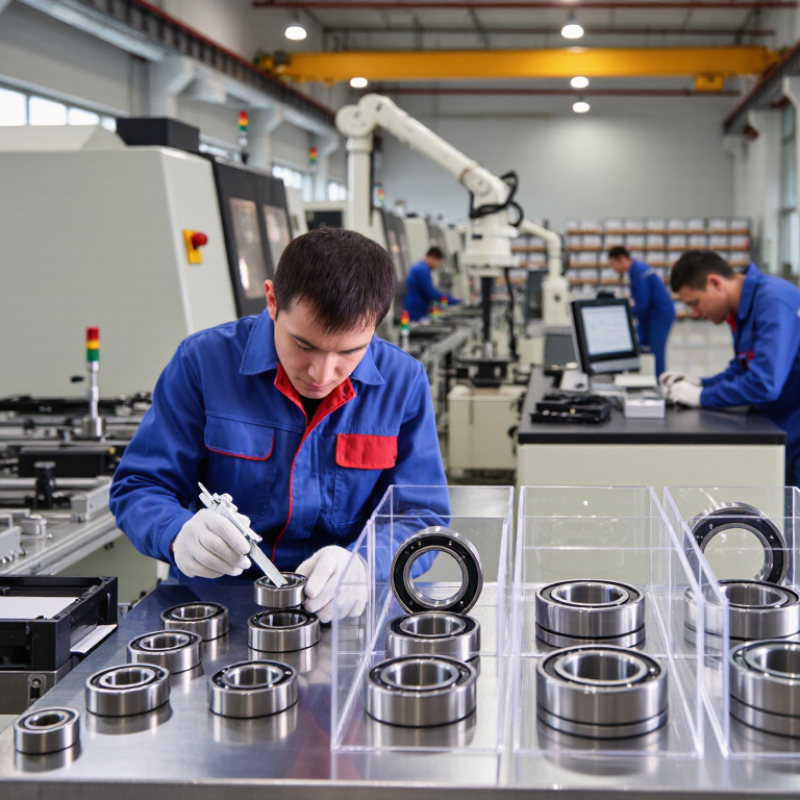
A capable needle bearing supplier needs more than modern equipment. It needs stable processes, trained operators, and clear evidence of control. In China, experienced factories often combine automatic turning, grinding, heat treatment, and precision assembly. Each stage affects load capacity, friction, noise, and service life.
Production begins with verified steel certificates and incoming material checks. Inspectors measure hardness, diameter, roundness, and surface condition. During machining, calibrated gauges monitor critical dimensions at defined intervals. Grinding rooms require temperature control because small changes can affect bearing accuracy. Assembly teams check roller placement, cage movement, and lubricant quantity. Clean workstations matter. Even fine metal dust can create early wear.
Quality control should continue after assembly. Suppliers can use noise testing, rotational inspection, hardness testing, and sampling-based endurance checks. Each batch should carry traceable records, including machine numbers, inspection results, and operator details. This supports faster investigation when a customer reports an issue. Experienced engineers also review packaging, rust protection, and shipping conditions.
No factory process is perfect. A supplier that admits recurring variation is more credible than one promising zero defects. We have seen inspection plans fail when workers treat them as paperwork. Regular calibration, process audits, and corrective actions make the system stronger. Customer drawings and operating conditions should guide final validation, not assumptions.
A reliable Chinese needle bearing supplier serves global buyers through more than competitive pricing. Export support should begin with accurate product data, including bore size, load rating, material, tolerance, and lubrication requirements. Clear drawings reduce mistakes between purchasing teams and factories. Samples help confirm fit before volume production.
Compliance deserves equal attention. A professional supplier can prepare commercial invoices, packing lists, certificates of origin, inspection reports, and material documentation. Product classification must match the destination market and shipment details. Importers should also verify labeling, safety, and customs requirements with local specialists. Regulations change. Assumptions can become expensive.
International logistics requires practical planning. Bearings should use sealed inner packaging, moisture protection, and strong cartons with visible quantity marks. A shipment plan may combine sea freight for routine orders and air freight for urgent replacements. Tracking should continue from factory release to customs clearance and final delivery. Delivery terms must be written clearly, including insurance and responsibility for duties. Not every shipment goes perfectly. A delayed inspection or missing document can disrupt production, so responsive communication matters. We still review each shipment afterward, because small process gaps are easy to overlook.
| Category | Buyer Data Dimension | Typical Information | Practical Guidance for Global Buyers |
|---|---|---|---|
| Product Scope | Needle bearing formats | Drawn-cup, machined-ring, thrust, roller, and track-type designs | Confirm the bearing structure, bore diameter, outside diameter, width, load direction, and whether an integrated seal or cage is required. |
| Product Scope | Dimensional specification | Metric and inch-based dimensions are available in the international market | Use a controlled drawing or a recognized bearing designation. Tolerance, clearance, chamfer, and mounting conditions should be stated before quotation. |
| Product Scope | Common material options | Hardened bearing steel; stainless steel for selected corrosion-resistant applications | Material selection should match load, speed, temperature, corrosion exposure, lubrication, and required service life. |
| Product Scope | Typical applications | Automotive systems, industrial machinery, gearboxes, pumps, agricultural equipment, and general motion assemblies | Application data should include radial or axial load, rotational speed, operating temperature, shaft hardness, housing fit, and expected operating hours. |
| Quality Control | Inspection documents | Dimensional report, material certificate, hardness result, noise or vibration record, and batch traceability | The exact inspection package should be agreed in the purchase order. A pre-shipment inspection can verify quantity, markings, packaging, and critical dimensions. |
| Quality Control | Quality management evidence | Common Quality-management certification or equivalent documented procedures | Request a current certificate, scope, validity period, and issuing body. Certification does not replace product-specific inspection or acceptance criteria. |
| Compliance | Export classification | HS classification for bearings is commonly associated with heading 8482, subject to product structure and destination rules | The final HS code must be confirmed by the exporter, customs broker, and importing-country customs authority because classification can vary by design and jurisdiction. |
| Compliance | Core export documents | Commercial invoice, packing list, sales contract, transport document, and export declaration | Document requirements depend on the destination and trade term. Ensure product description, quantity, net weight, gross weight, origin, and customs data are consistent. |
| Compliance | Country-of-origin information | Required where applicable Origin statement or certificate of origin | Some destinations require a preferential or non-preferential certificate. Origin claims must reflect the applicable rules of origin and manufacturing process. |
| Compliance | Product regulatory screening | Application-dependent Chemical, environmental, packaging, and market-access requirements | Needle bearings are generally mechanical products, but packaging materials, lubricants, coatings, and destination-specific chemical rules may create additional obligations. |
| Trade Terms | Recommended Incoterms discussion | EXW, FCA, FOB, CIF, CPT, CIP, DAP, and DDP may be considered | The selected Incoterm determines responsibility for export clearance, freight, insurance, import clearance, taxes, and final delivery. State the named place clearly. |
| Trade Terms | Payment structures | Advance payment, documentary collection, letter of credit, or account terms for approved buyers | Payment timing should be linked to order confirmation, production completion, inspection approval, and release of shipping documents. |
| Production | Sample order lead time | Often several working days to several weeks, depending on availability and customization | Lead time increases when tooling, special heat treatment, non-standard materials, custom packaging, or additional inspection is required. |
| Production | Mass-production lead time | Commonly several weeks after drawing, specification, and payment terms are approved | Ask for a written production schedule covering material preparation, machining, heat treatment, finishing, assembly, inspection, and packing. |
| Packaging | Standard export packaging | Individual protection, inner boxes or tubes, moisture control, and reinforced outer cartons or pallets | Packaging should prevent impact, contamination, corrosion, and mixed-lot identification problems during ocean, air, rail, or courier transport. |
| Logistics | Air freight suitability | Suitable for urgent, compact, and relatively high-value shipments | Air freight generally offers shorter transit time but higher cost. Confirm chargeable weight, airport handling, customs brokerage, and delivery address. |
| Logistics | Ocean freight suitability | Suitable for larger, heavier, and planned replenishment shipments | Compare full-container and less-than-container-load options. Transit time varies by route, port congestion, sailing schedule, and destination clearance. |
| Logistics | Courier or express shipping | Suitable for samples and small urgent consignments | Confirm whether customs duties, brokerage, remote-area fees, and import taxes are included in the quoted delivery charge. |
| Logistics | Cargo insurance | Recommended Insurance based on cargo value and agreed trade term | Check insured risks, exclusions, claim procedures, currency, deductible, and whether coverage applies from the supplier’s facility to the final destination. |
| Commercial Review | Quotation comparison factors | Unit price, tooling, minimum order quantity, lead time, packaging, inspection, freight, duty, and payment terms | Compare quotations on the same specification and Incoterm. A lower unit price may not represent a lower total landed cost. |
| Commercial Review | Supplier verification questions | Manufacturing capability, outsourcing percentage, traceability, inspection equipment, export experience, and after-sales process | Request production photos, sample inspection records, technical drawings, references to applicable standards, and a clear process for non-conforming goods. |
Note: Lead times, logistics costs, customs requirements, and applicable standards vary by product specification, destination, order quantity, season, and trade term. All commercial and regulatory details should be confirmed before purchase.
Supplier selection should begin with evidence, not attractive pricing. The U.S. Department of Energy reports that motor-driven systems use about 70% of industrial electricity. Bearing friction and service life therefore affect operating costs. Ask suppliers for load ratings, tolerance data, heat-treatment records, and batch traceability. Verify these documents against ISO 281 for rating life and ISO 492 for dimensional accuracy.
A capable factory should explain its steel source, grinding process, cage design, and inspection frequency. Request samples from normal production, not specially prepared pieces. Measure bore diameter, radial clearance, surface roughness, and needle hardness through an independent laboratory. The 2023 Global Bearing Market Outlook, published by an international market research firm, identifies industrial automation and vehicle efficiency as major demand drivers. That pressure makes consistent quality more valuable than the lowest quotation.
Audit communication as carefully as machinery. Can the supplier answer technical questions clearly? Does it report nonconforming parts honestly? A practical factory visit should include incoming inspection, clean assembly areas, calibrated gauges, and sealed storage. Documentation may look impressive. Production reality can differ. I would also compare lead times across three orders, because one successful shipment proves very little. Ask for corrective-action reports, warranty terms, and export packing details. Small omissions matter. A supplier that welcomes verification usually presents lower long-term risk.