How to Choose the Right Deep Ball Bearing
Choosing the right Deep Ball Bearing starts with the machine, not the product catalog. Shaft diameter matters, but it is only one decision. Load direction, speed, temperature, vibration, lubrication, and contamination must be examined together. A bearing exposed to fine dust needs a different sealing strategy from one running inside a clean electric motor. Small details matter. Grease leakage can signal trouble.
Grand View Research reported continued expansion in the global ball bearing market, driven by automotive, industrial machinery, and renewable-energy applications. Fortune Business Insights estimated the market at USD 18.89 billion in 2023, with further growth expected through 2032. These reports show demand rising, but market growth does not simplify selection. It increases the cost of choosing badly. The wrong clearance can create heat. Excessive preload can shorten service life. A cheaper unit may also carry higher maintenance risk.
Dr. Tedric A. Harris, a respected rolling-bearing authority and author of Rolling Bearing Analysis, stated, “Bearing life is an application result, not merely a catalog number.” That principle deserves attention. ISO 281 life calculations provide a useful baseline, yet real conditions can differ sharply. Misalignment, moisture, poor fitting, and interrupted lubrication may reduce performance. This guide examines bore size, dynamic load rating, internal clearance, seals, cage materials, and operating environment. It also questions a common assumption: the highest-rated bearing is not always the best choice. Sometimes, a simpler bearing with better sealing delivers more dependable service.
Understanding Deep Ball Bearing Types and Their Applications
Choosing the right deep ball bearing starts with its construction, not its catalog label.
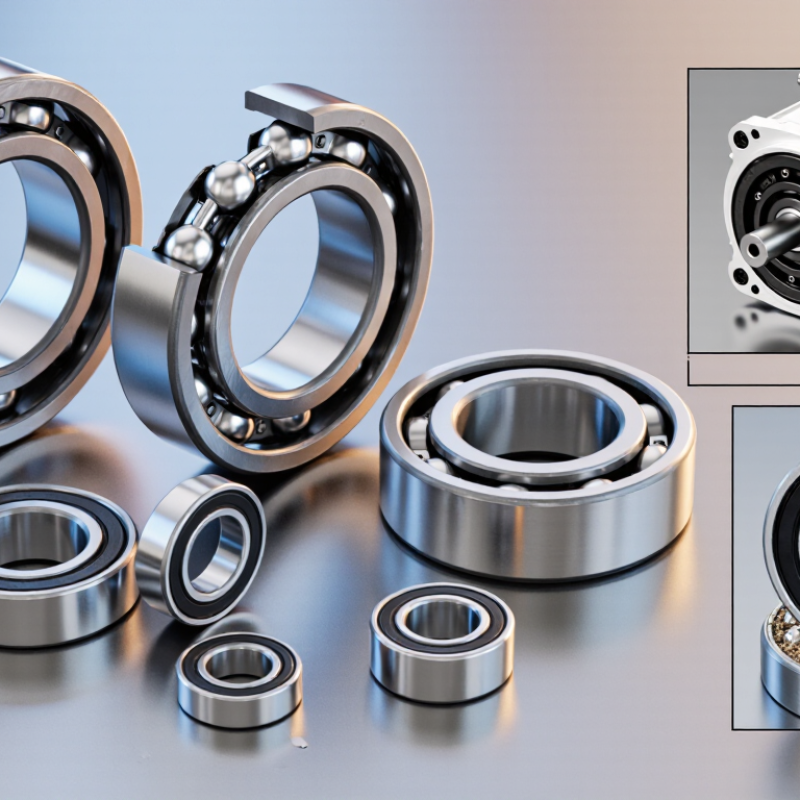
Single-row bearings suit electric motors, pumps, fans, and conveyor rollers. They handle radial loads and moderate axial loads from both directions. Double-row versions provide greater radial capacity in compact housings. They fit heavier machinery, but installation errors become less forgiving.
Sealed and shielded designs serve different operating conditions.
Sealed bearings retain grease and resist dust, making them practical for small motors and agricultural equipment. Shielded designs reduce friction, yet they offer less protection in wet or dirty areas. Stainless steel types tolerate moisture and mild corrosion. High-temperature variants need suitable grease, not only heat-resistant metal. ISO 281:2007 calculates basic rating life from load and dynamic load rating, but real service life also depends on lubrication, contamination, and alignment.
Match the bearing to the duty cycle.
A high-speed fan needs low friction and balanced seals. A conveyor near abrasive dust needs stronger exclusion and frequent inspection. The U.S. Department of Energy reports that motor-driven systems can consume 60–70% of industrial electricity, so small friction losses can become expensive. I have seen selections fail because engineers checked load capacity but ignored shaft fits. That mistake is easy to repeat. Check clearance, operating temperature, mounting tolerance, and expected shock before approval. A larger bearing is not automatically safer.
Identifying Load, Speed, and Operating Condition Requirements
How to Choose the Right Deep Ball Bearing
Identifying load, speed, and operating conditions is essential when selecting a deep ball bearing. Start by measuring both radial and axial loads, not just the machine’s rated capacity. A belt drive may add constant radial force, while a helical gear can create noticeable axial force. Check the expected load changes during startup, stopping, and unexpected overloads. A bearing that survives normal running may still fail during repeated shock loads.
Speed also affects bearing selection. Compare the required rotational speed with the bearing’s reference speed and lubrication method. Grease can be practical for moderate speeds, but oil may control heat more effectively in demanding applications. Calculate expected bearing life using realistic loads and duty cycles. Clean calculations can still mislead. I have seen premature failures caused by underestimated startup loads and poor alignment.
Tips: Inspect the shaft and housing fits before ordering. Measure operating temperature near the bearing, not several inches away. Consider dust, moisture, vibration, and washdown exposure. Sealed bearings may simplify maintenance, but seals can increase friction and heat. Choose internal clearance carefully, especially when the shaft runs hot. If the application has frequent temperature changes, test a sample under actual conditions. Small details matter. Keep installation tools clean, and never force the ring through the rolling elements.
Comparing Seals, Shields, Lubrication, and Maintenance Needs
Choosing the right deep ball bearing starts with the operating environment, not catalog load ratings. In a clean electric motor, open bearings may reduce friction, but exposed races need frequent relubrication. I usually prefer shields where dust is light and temperatures remain moderate. Shields limit particle entry without touching the inner ring. They also create less drag. Seals provide stronger contamination control. Use them near water, powder, or washdown spray. Contact seals add resistance and may increase heat. That tradeoff is easy to miss.
Lubrication must match speed, load, and temperature.
A bearing filled with too much grease can run hot, especially at high rpm. Too little grease leaves polished tracks vulnerable to wear. Check the manufacturer’s fill guidance and relubrication interval. Do not mix greases without confirming compatibility. Different thickeners can separate or harden. In field work, I inspect grease color, noise, and housing temperature together. One sign alone can mislead. A cool housing does not always mean healthy rolling contact.
Maintenance access should influence the seal choice. An inaccessible bearing often benefits from a sealed, factory-lubricated design. A serviceable bearing may suit shields and scheduled grease replacement. Keep the shaft and housing clean during installation. Even a small metal chip can mark a raceway. Measure vibration when possible, then compare readings over time. I once treated a rising hum as normal and replaced the wrong component. That mistake cost more downtime than the bearing. Clearance also deserves attention. Tight fits, thermal expansion, and misalignment can change operating behavior. Review the actual duty cycle before selecting the final bearing.
Verifying Quality, Compatibility, and Installation Requirements
Choosing the right deep ball bearing starts with verified quality, not a familiar size. Check dimensional tolerances, material certificates, heat treatment records, and inspection results. ISO 281 defines bearing rating life through the L10 value, where 90% of identical bearings are expected to reach the calculated life. This is a statistical estimate, not a promise. Load, speed, contamination, and lubrication can reduce it sharply.
Compatibility requires more than matching the shaft diameter. Confirm bore, outside diameter, width, radial clearance, sealing arrangement, load direction, operating temperature, and rotating speed. ISO 76 helps assess static load capacity, while ISO 15243 classifies damage such as flaking, smearing, and corrosion. The U.S. Department of Energy reports that motor-driven systems use about 23% of U.S. electricity, making small efficiency losses worth investigating. A slightly wrong fit may create heat, vibration, and unnecessary energy use. I have seen installation errors defeat otherwise excellent components.
Tips: Measure the shaft and housing at several points. Clean both surfaces carefully. Use the correct press force. Never strike the rolling elements. Apply the specified lubricant quantity. Record temperature and vibration after startup. Check alignment before increasing speed. A checklist helps, but it can still miss a housing distortion or an overlooked electrical current path. When uncertainty remains, review the manufacturer-neutral specification against ISO requirements and the actual operating duty.